
Home / 929 vs 917: Outer-Borough Code vs Citywide Mobile Code
929 vs 917: Outer-Borough Code vs Citywide Mobile Code
929 belongs to the outer boroughs. 917 belongs to the whole city. That single coverage difference explains almost everything people ask when they compare these two New York codes.
929 Area Code Guide
Two Codes, Two Different Maps
The 929 vs 917 comparison is the one comparison in New York where the maps genuinely differ. Area code 929 covers Brooklyn, Queens, the Bronx, Staten Island and Marble Hill, and it does not cover Manhattan proper. Area code 917 covers all five boroughs, including Manhattan. A 917 number tells you the line is a New York City number. A 929 number tells you more: it points to the outer boroughs specifically.
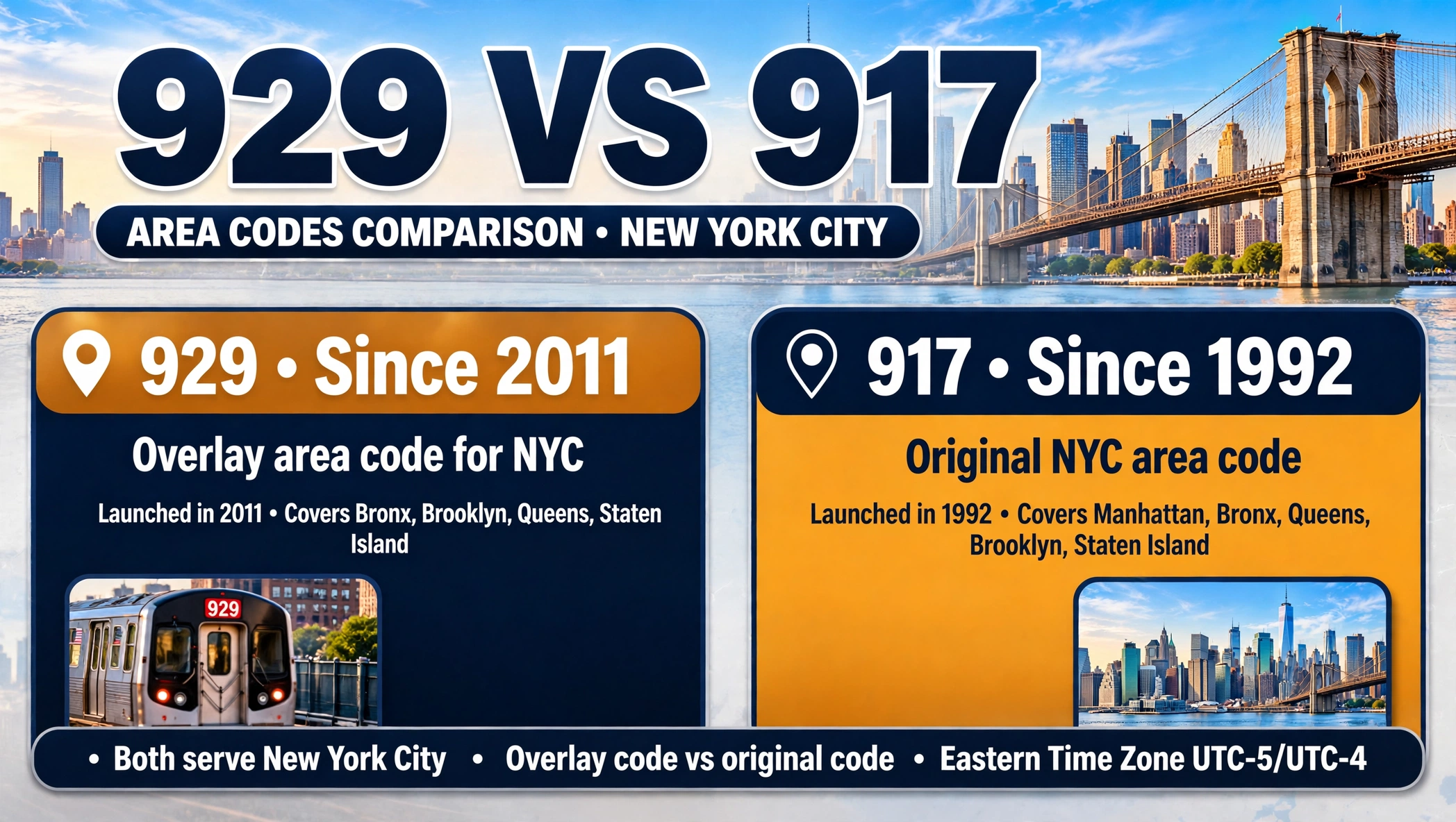
917 was introduced in 1992 and was originally assigned heavily to mobile phones and pagers, at a time when carriers kept mobile numbers separate from landline numbers. That history is why many New Yorkers still read 917 as a mobile code. Today that restriction is long gone: 917 is now used for any line type, and 929 is used for any line type too. Either code can sit on a mobile phone, a landline or a VoIP line.
Coverage and History Compared
| Feature | 929 | 917 |
|---|---|---|
| Introduced | 16 April 2011 | 1992 |
| Covers | Brooklyn, Queens, Bronx, Staten Island, Marble Hill | All five boroughs, including Manhattan |
| Original role | Overlay adding number supply | Assigned heavily to mobile phones and pagers |
| Line types today | Any: mobile, landline, VoIP | Any: mobile, landline, VoIP |
| Overlay family | Overlays 718 and 347 | Citywide code used across both NYC complexes |
| Dialing | 10 digits | 10 digits |
The history explains the shapes. The outer-borough complex began when 718 split from 212 in 1984, then gained the 347 overlay in 1999, the 929 overlay in 2011 and the 465 overlay in 2026. Manhattan followed its own path with 646 in 1999 and 332 in 2017. 917 was drawn differently from the start: it was laid across the entire city in 1992, before the two complexes hardened into their modern forms, and it has kept that citywide footprint ever since.
Because 917 numbers were handed to mobile users for years, a large share of long held personal numbers in New York are 917 numbers that their owners have carried from phone to phone. Number portability lets people keep those numbers when they switch carriers, so the code’s mobile reputation renews itself even though new 917 assignments can now be any line type.
What Each Code Signals to Callers
Phone numbers carry signals, and these two codes send different ones. A 929 number says outer-borough New York clearly. For a Brooklyn bakery, a Queens contractor or a Bronx clinic, that is often exactly the right signal: it tells nearby customers that the business is one of their own, in a city where neighbourhood loyalty runs deep. NumberBarn’s 2025 study ranked 929 the number 1 most purchased area code in the United States in 2024-25, which suggests buyers actively seek that signal rather than merely accepting it.
A 917 number says New York City as a whole. It is the code of the long time mobile user, the freelancer who works in Manhattan on Monday and Brooklyn on Tuesday, and the business that serves clients in every borough and does not want to sound tied to one side of the East River. Neither signal is stronger in every situation. The question is which geography you want your number to describe.
- Choose 929 if your customers, clients or community are in the outer boroughs and local recognition matters.
- Choose 917 if you work across all five boroughs or want the classic citywide mobile identity.
- Either works technically. Coverage for calling is identical in practice, since both are New York City codes dialed with 10 digits.
Getting and Keeping Either Number
Availability is the practical catch. Both codes are in demand, and carriers assign from the blocks they hold. You can request a code when you open a line, search virtual number inventories by code, or buy a specific available number from a marketplace and port it to your provider. Porting typically takes 3 to 5 days for mobile numbers and 7 to 14 days for landline or VoIP numbers, and you must keep the old service active until the port completes.
If you already hold a 917 number from the pager and early mobile era, treat it as an asset. Numbers with that kind of tenure are rarely surrendered, and portability means you never need to give one up just to change carriers or move between boroughs. The same advice applies to a good 929 number once you have printed it on signage, vehicles and listings. In a city running four codes on the outer boroughs alone, a number people already know is worth more than any particular three digits in front of it.
Keep Exploring
These guides connect directly to this topic and use the same verified facts about the New York City numbering plan.
Back to 929 Complete GuideFrequently Asked Questions
Does 929 cover Manhattan like 917 does?
No. 917 covers all five boroughs including Manhattan. 929 covers Brooklyn, Queens, the Bronx, Staten Island and Marble Hill only.
Is 917 only for cell phones?
No. 917 was originally assigned heavily to mobile phones and pagers after its introduction in 1992, but it is now used for any line type.
Which code is older, 929 or 917?
917 is older. It was introduced in 1992, while 929 entered service on 16 April 2011.
Can a 929 number and a 917 number reach each other as local calls?
Yes. Both are New York City area codes and are dialed with 10 digits like every other number in the city.
Which code is better for an outer-borough business?
929 signals the outer boroughs specifically, which many local businesses prefer. 917 signals the whole city. Both work identically.
Can I keep my 917 number if I switch carriers?
Yes. Number portability lets you keep your number. Mobile ports typically take 3 to 5 days and the old service must stay active until the port completes.