Home / All New York City Area Codes: 212, 332, 646, 917, 718, 347, 929 and 465
All New York City Area Codes: 212, 332, 646, 917, 718, 347, 929 and 465
New York City runs on eight area codes across two numbering complexes and one citywide code. This hub lists every one of them, with the year it arrived, the boroughs it covers and how it was created.
929 Area Code Guide
Eight Codes, One City
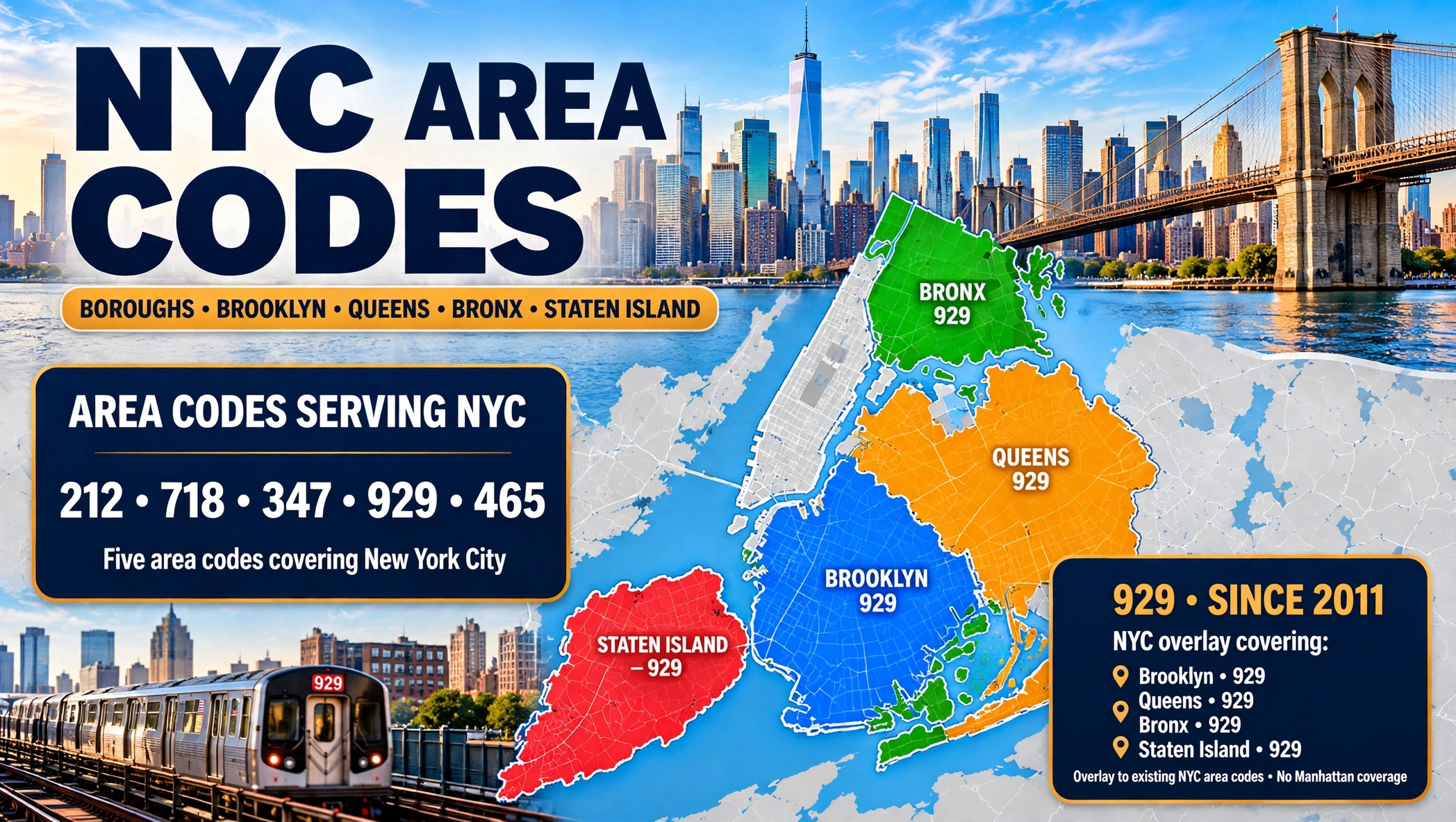
There are eight New York City area codes: 212, 332, 646, 917, 718, 347, 929 and 465. They divide into three groups. Manhattan has 212, 646 and 332. The outer boroughs, meaning Brooklyn, Queens, the Bronx, Staten Island and Marble Hill, have 718, 347, 929 and 465. And 917 stands apart, covering all five boroughs at once. Every one of these codes is dialed with 10 digits, because 10-digit dialing is mandatory everywhere in New York City.
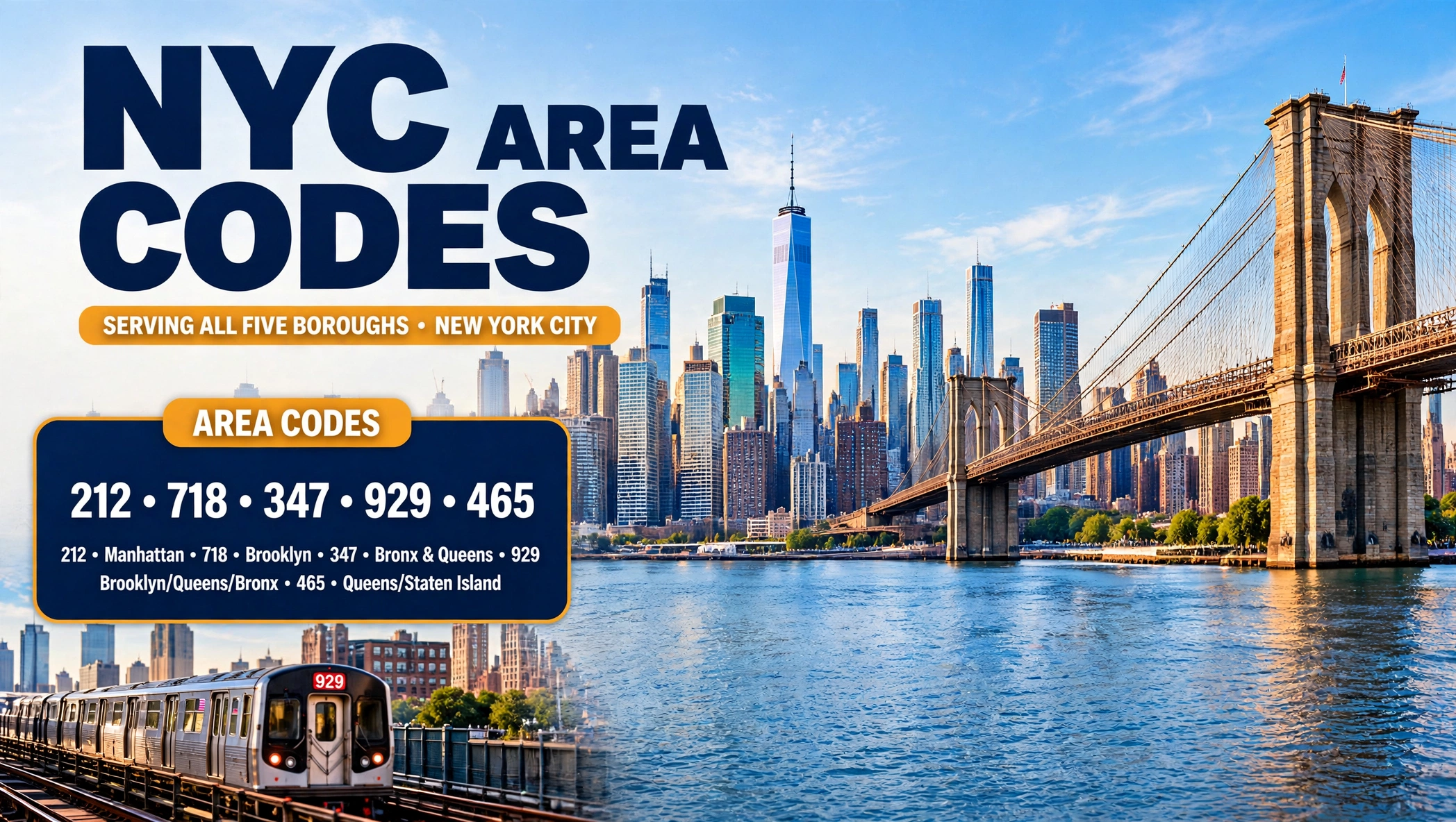
The system grew in layers over almost eighty years. It began with a single code, 212, in 1947. Splits divided the city, then overlays added supply without moving borders. Understanding which group a code belongs to answers most questions people ask about New York numbers: where a number is from, whether it is new or old, and why two neighbours can hold completely different codes.
The Complete New York City Area Code Table
| Code | Year | Covers | Type |
|---|---|---|---|
| 212 | 1947 | Manhattan (originally all of NYC) | Original code |
| 718 | 1984 | Brooklyn, Queens, Bronx, Staten Island, Marble Hill | Split from 212 |
| 917 | 1992 | All five boroughs | Citywide code, heavily mobile and pagers at first |
| 347 | 1999 | Outer boroughs and Marble Hill | Overlay on 718 |
| 646 | 1999 | Manhattan | Overlay on 212 |
| 929 | 2011 | Outer boroughs and Marble Hill | Overlay on 718 and 347 |
| 332 | 2017 | Manhattan | Overlay on 212 and 646 |
| 465 | 2026 | Outer boroughs and Marble Hill | Overlay on 718, 347 and 929 |
Two patterns stand out in the table. First, the split era ended early: 718 in 1984 was the great division, and everything after it in New York City has been an overlay, because overlays add numbers without forcing anyone to change theirs. Second, the two complexes have grown in parallel. Manhattan added 646 in 1999 and 332 in 2017. The outer boroughs added 347 in 1999, 929 in 2011 and 465 in 2026. The outer boroughs carry one more code because they hold far more people and far more lines.
The newest entry, 465, went live on 18 June 2026 and is New York’s first area code starting with 4. Its numbers will be assigned only as the existing codes exhaust, forecast around the third quarter of 2027, so for now the code you are most likely to be offered on a new outer-borough line is still 929, 347 or 718.
How to Read a New York Number at a Glance
With the table in mind, a New York number tells you its story in a second. A 212, 646 or 332 number belongs to the Manhattan complex. A 718, 347, 929 or 465 number belongs to the outer boroughs. A 917 number belongs to the whole city and was originally assigned heavily to mobile phones and pagers, though it is now used for any line type. What a number cannot tell you is its current carrier or even, with certainty, where its owner lives today, because number portability lets people keep numbers when they move and switch providers.
- Oldest: 212 from 1947, the original code for the entire city.
- Newest: 465 from 2026, the first New York code starting with 4.
- Most purchased: 929, ranked number 1 in the United States in NumberBarn’s 2025 study of 2024-25 purchases.
- Only citywide code: 917, covering all five boroughs since 1992.
- Shared rule: every New York City number is dialed with all 10 digits.
This hub is the parent page for the city’s code family. From here you can go deeper on the newest code, compare the outer-borough codes against each other, or step back to the full New York State list to see how the city’s eight codes fit into the state’s wider numbering map.
Why the City Keeps Adding Codes
Each addition followed the same arithmetic. A numbering area holds a fixed pool of possible numbers. Households once needed one line each. Then came second lines, fax machines, pagers, mobile phones for every person, tablets and connected devices, and a vast market in business and virtual numbers. Each wave consumed the pool faster, and each overlay refilled it without disturbing existing customers.
Regulators choose overlays over splits in built up areas for a practical reason: a split forces half the affected customers to change numbers, stationery, signage and listings, while an overlay asks only for 10-digit dialing, which New York adopted long ago. That is why the city’s map has been stable since 1984 even as its code count has grown from one to eight. The borders stayed humane. The labels multiplied. And with 465 now in service, the outer boroughs have supply cover that should last well into the next decade of growth.
Keep Exploring
These guides connect directly to this topic and use the same verified facts about the New York City numbering plan.
Back to 929 Complete GuideFrequently Asked Questions
How many area codes does New York City have?
New York City has eight area codes: 212, 332 and 646 for Manhattan, 718, 347, 929 and 465 for the outer boroughs, and 917 covering all five boroughs.
What is the newest New York City area code?
465 is the newest. It went live on 18 June 2026 as an overlay on the outer boroughs and is New York’s first area code starting with 4.
What is the oldest New York City area code?
212 is the oldest. It was the original 1947 code for all of New York City and now covers Manhattan only.
Which New York City area code covers all five boroughs?
Only 917 covers all five boroughs. It was introduced in 1992 and was originally assigned heavily to mobile phones and pagers.
Why are there so many area codes in New York City?
Demand for numbers outgrew each pool. Splits and then overlays added supply: 718 in 1984, 917 in 1992, 347 and 646 in 1999, 929 in 2011, 332 in 2017 and 465 in 2026.
Do I dial 10 digits for every New York City code?
Yes. Ten digit dialing is mandatory everywhere in New York City for all eight codes.