Home / 929 vs 212: New Outer-Borough Code vs the Original Manhattan Code
929 vs 212: New Outer-Borough Code vs the Original Manhattan Code
212 is where New York telephones began in 1947. 929 is one of the newest chapters of the same story. They cover different boroughs, carry different reputations, and work exactly the same way.
929 Area Code Guide
The Original and the Newcomer
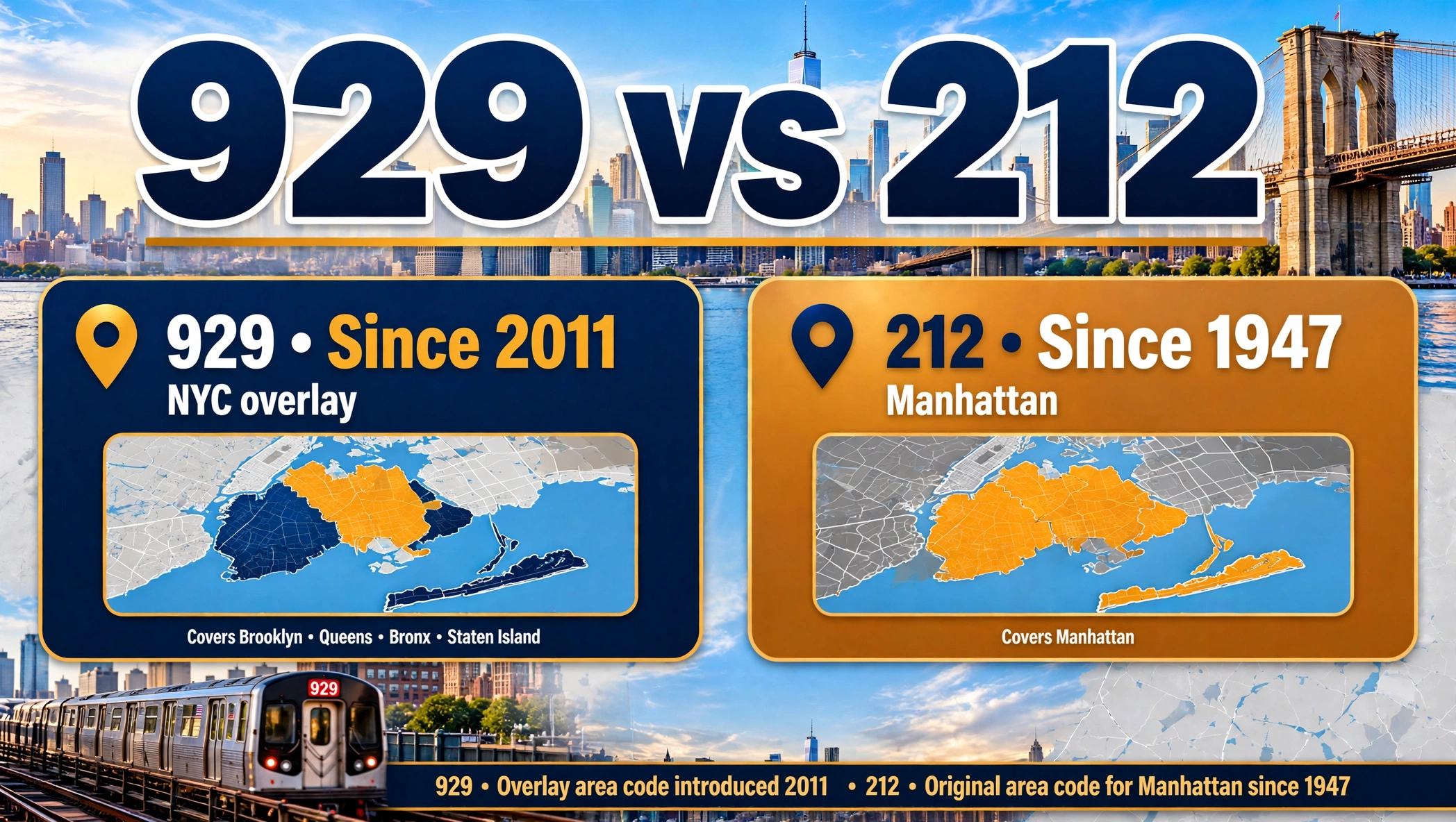
Every 929 vs 212 conversation is really two conversations. The first is geography: 212 covers Manhattan, while 929 covers Brooklyn, Queens, the Bronx, Staten Island and Marble Hill. The second is reputation: 212 is the most famous area code in America, a code people associate with old New York, established firms and a Manhattan address, while 929 is a modern outer-borough code that New Yorkers have adopted at remarkable speed.
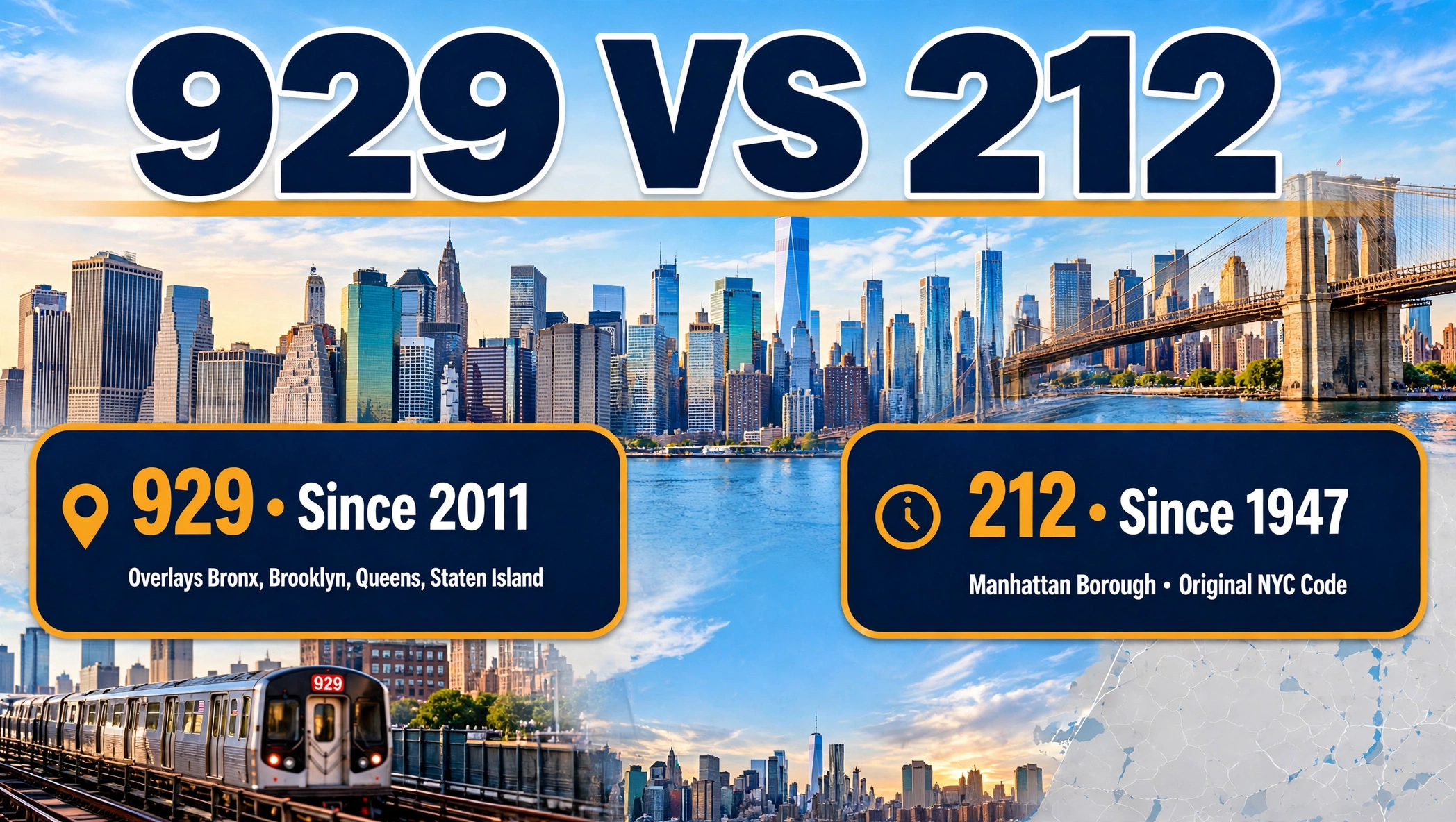
Start with the facts. 212 is the original 1947 code for all of New York City. In 1947 one code served the whole city. Splits then divided that territory: 718 split from 212 in 1984 to serve the outer boroughs, and 212 shrank over time until it meant Manhattan only, as it does today. 929 arrived much later, entering service on 16 April 2011 as an overlay on 718 and 347, with no split and no forced number changes.
Coverage, History and Status Compared
| Feature | 212 | 929 |
|---|---|---|
| Introduced | 1947, original code for all of NYC | 16 April 2011 |
| Covers today | Manhattan only | Brooklyn, Queens, Bronx, Staten Island, Marble Hill |
| How it arrived | Original code, later reduced by splits | Overlay on 718 and 347 |
| Companion codes | 646 (1999) and 332 (2017) in Manhattan | 718, 347 and 465 on the same outer-borough map |
| Reputation | Classic, prestigious, scarce | Modern, local, in high demand |
| Dialing | 10 digits | 10 digits |
Manhattan gained its own overlays as demand grew: 646 as a Manhattan overlay in 1999 and 332 as a Manhattan overlay in 2017. That means a Manhattan business today is at least as likely to hold a 646 or 332 number as a 212 number, and customers manage fine with all three. The outer boroughs followed the same logic a step behind, adding 347 in 1999, 929 in 2011 and 465 in 2026. Seen this way, 929 is simply the outer boroughs’ equivalent of what 646 and 332 are to Manhattan: the working modern code of its territory.
Scarcity is the honest difference. 212 numbers have been recycled and reissued for decades and genuinely new ones are rare, which feeds the code’s prestige and its resale market. 929 numbers, while popular, are still a living, assigning code, available through normal channels today.
Does the Prestige Gap Actually Matter?
For some businesses, yes, and for most, no. A Manhattan law firm or gallery that trades on a Manhattan identity may value a 212 number the way it values its address. Customers in that world notice the code, and the code confirms the story the business tells about itself. There is nothing irrational about that: area codes are one of the few pieces of branding that appear on every invoice, card and listing.
For an outer-borough business, the logic runs the other way. A 929 number confirms a Brooklyn, Queens, Bronx or Staten Island identity, and for local customers that confirmation builds trust rather than costing it. The market seems to agree: NumberBarn’s 2025 study ranked 929 the number 1 most purchased area code in the United States in 2024-25. Buyers are not settling for 929. In large numbers, they are choosing it, because the outer boroughs are where much of the city’s growth, food, culture and small business energy now sits.
- 212 fits a Manhattan centred identity and clients who expect a Manhattan address.
- 929 fits an outer-borough identity and customers who value a local, neighbourhood presence.
- Neither code changes call quality, features or how far your number can reach. Both are dialed with 10 digits everywhere in New York City.
Can You Get a 212 Number, or Should You Take 929?
You can try for 212, but set expectations honestly. Carriers assign from blocks they hold, 212 blocks are scarce, and many people who want one end up buying an existing number from a marketplace and porting it in. Porting typically takes 3 to 5 days for mobile and 7 to 14 days for landline or VoIP, and the account details must match exactly for the port to succeed. A Manhattan address is not required to hold a 212 number in the virtual number era, but scarcity, not eligibility, is the real barrier.
929 is straightforward by comparison. Mobile carriers, landline carriers and VoIP and virtual number providers can all assign 929 numbers while their blocks last, and Google Voice may offer one subject to availability. If your business is actually in the outer boroughs, a 929 number also has the virtue of being true: it matches your storefront, your delivery zone and your customers’ own numbers. In the long run, the number that matches where you really are tends to be the number that works hardest for you.
Keep Exploring
These guides connect directly to this topic and use the same verified facts about the New York City numbering plan.
Back to 929 Complete GuideFrequently Asked Questions
Is 929 a Manhattan area code like 212?
No. 929 covers the outer boroughs and Marble Hill. Manhattan uses 212, 646 and 332.
Why is 212 so famous?
212 is the original 1947 area code for all of New York City. It now covers Manhattan only, and its age and scarcity give it a prestige no other city code matches.
When did 718 split from 212?
718 was introduced in 1984 as a split from 212, creating the outer-borough numbering area that later gained the 347, 929 and 465 overlays.
Can a business outside Manhattan use a 212 number?
It can be possible through virtual providers or by buying and porting an existing number, but 212 numbers are scarce. A 929 number is far easier to obtain.
Do 212 and 929 calls cost the same to make?
Both are normal New York City numbers dialed with 10 digits. Neither is toll free and neither carries a premium charge by itself.
Which code should a Brooklyn business choose?
Most Brooklyn businesses choose 929, 718 or 347 because those codes match their actual location and their customers’ expectations.