Home > Safety > 929 Text Messages
929 Area Code Text Messages: Is That Text a Scam?
A text from a 929 number can be a genuine message from a New Yorker, or a scam wearing a local costume. This guide shows how to tell the difference, what the common 929 text scams look like, and exactly what to do next.
929 Area Code Guide | Eastern Time (ET)
The Short Answer: A 929 Text Proves Nothing by Itself
Start with the fact that explains everything else on this page. The 929 area code is a legitimate New York City code. It serves Brooklyn, Queens, the Bronx, Staten Island and Marble Hill, on Eastern Time, as part of the overlay stack with 718 from 1984, 347 from 1999 and 465 from June 2026. Millions of real people and businesses hold real 929 numbers. At the same time, scammers heavily spoof 929 numbers, meaning they display a 929 number they do not own, precisely because a local looking New York code makes a message feel trustworthy. So a 929 number on a text does not prove the sender is in New York, does not prove the sender is genuine, and does not prove the message is safe.
Judge every unexpected 929 text by its content, not its area code. Scam texts share a pattern: they arrive uninvited, they create urgency or curiosity, and they push you toward an action the sender controls, tapping a link, replying with a code, calling a number in the message, or continuing a conversation. Genuine organisations do contact customers by text, but they do not need you to panic, pay through unusual methods, or hand over passwords and one time codes. When a message pressures you to act fast and keep it quiet, that pressure itself is the warning sign.
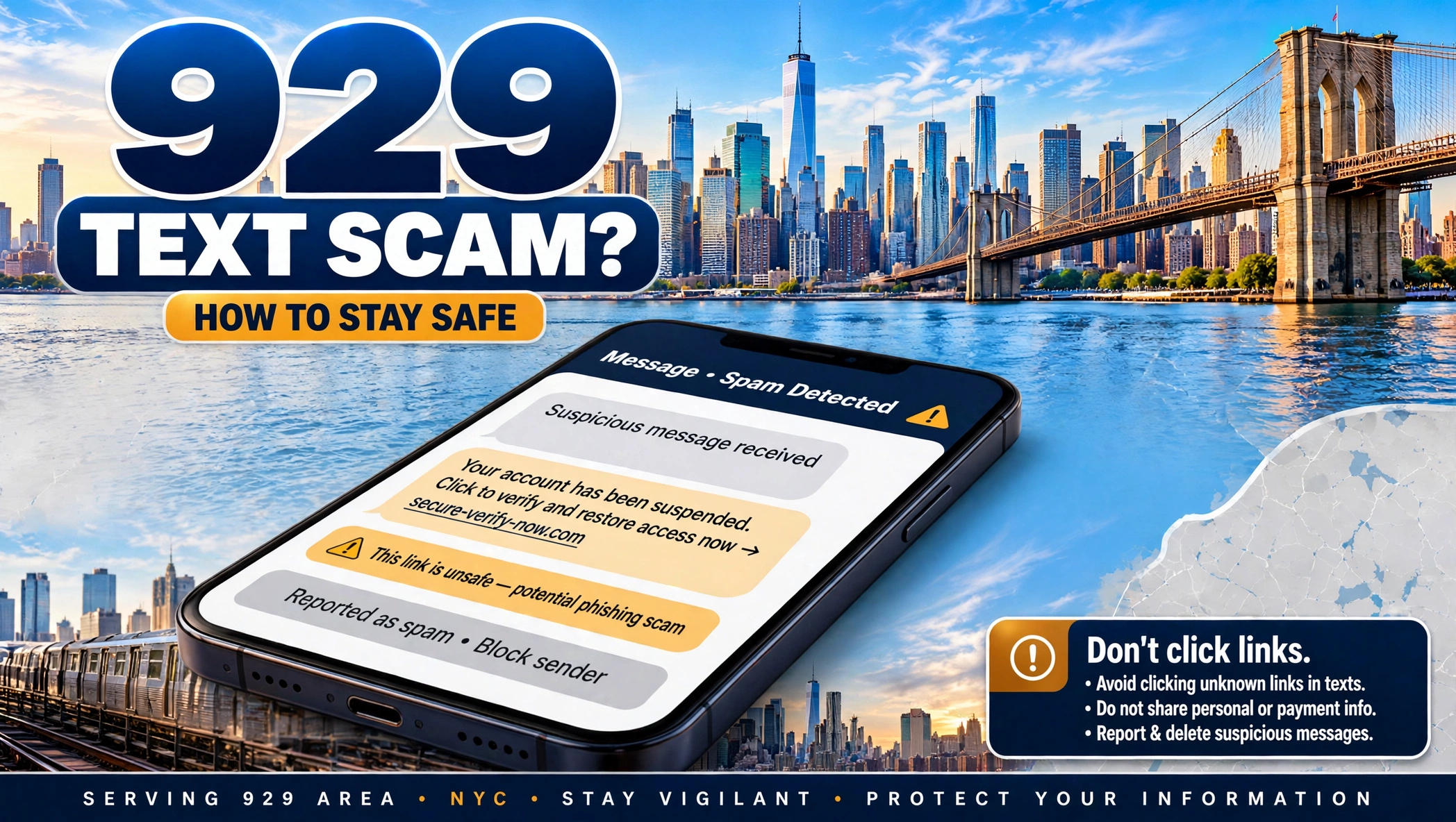
Common 929 Text Scams to Recognise
The same well documented text scams appear again and again behind spoofed 929 numbers. Learning their shapes is the fastest protection, because the scripts change far less than the numbers do.
Package delivery texts
A message claims a parcel is held, delayed or needs a small fee or updated details, and includes a link. The link leads to a copy of a delivery company site designed to steal payment details or personal information. Real delivery problems can be checked safely in the courier app or site you open yourself, never through the link in an unsolicited text.
Bank fraud alert texts
A message claims your bank has spotted a suspicious charge and asks you to reply yes or no, tap a link, or call a number to secure the account. That contact route belongs to the scammer. Banks do send fraud alerts, which is why this works, but the safe response is always the same: ignore the number in the text and contact your bank through the number on your card or its official app.
Wrong number texts that build a conversation
A friendly message appears to be meant for someone else, perhaps about a meeting, a photo or a business matter. If you reply that it is the wrong number, the sender apologises, stays charming, and tries to keep talking. Over days the chat can drift toward friendship, romance or an investment opportunity. This slow build is deliberate. A polite wrong number that refuses to end is a script, and the safest move is to stop replying and block the number.
Job offer and other lure texts
Other common lures include job offers that arrive out of nowhere and move quickly toward training fees or equipment payments, prize and refund claims, and messages impersonating government or utility services with threats about benefits, fines or shutoffs. Government offices and utilities do not settle urgent debts through links in surprise texts. Treat any unexpected money request, in either direction, as a red flag.
A Step by Step Check Before You Respond
When a 929 text feels even slightly off, run through this check before doing anything the message asks.
- Stop. Scam texts are built around speed. A short pause defeats most of them.
- Do not tap the link and do not call the number in the message. Both were chosen by the sender.
- Look for pressure and secrecy. Deadlines, threats and requests not to tell anyone are classic signs.
- Verify independently. Open the official app or site yourself, or use a number from your card, bill or statement, and ask whether the message is real.
- Never share codes. A one time code sent to your phone is for you alone. Anyone asking you to read it out or forward it is trying to enter your account.
- Block and report. Block the number in your phone and forward the spam text to 7726 so your carrier can act on it.
If you already tapped a link or shared information, act promptly and calmly. Change the password on any account involved, turn on stronger sign in protection where available, watch your bank activity, and contact your bank directly if payment details were entered. Reporting quickly matters more than feeling embarrassed. These scripts are designed by professionals to fool careful people, and they succeed often enough that carriers and regulators treat text fraud as a standing problem, not a personal failure.
Remember too that replying, even to say stop, can confirm your number is active and invite more messages. For marketing texts from a real business you signed up with, the normal opt out route is fine. For anything that smells like fraud, silence, blocking and reporting beat engagement every time.
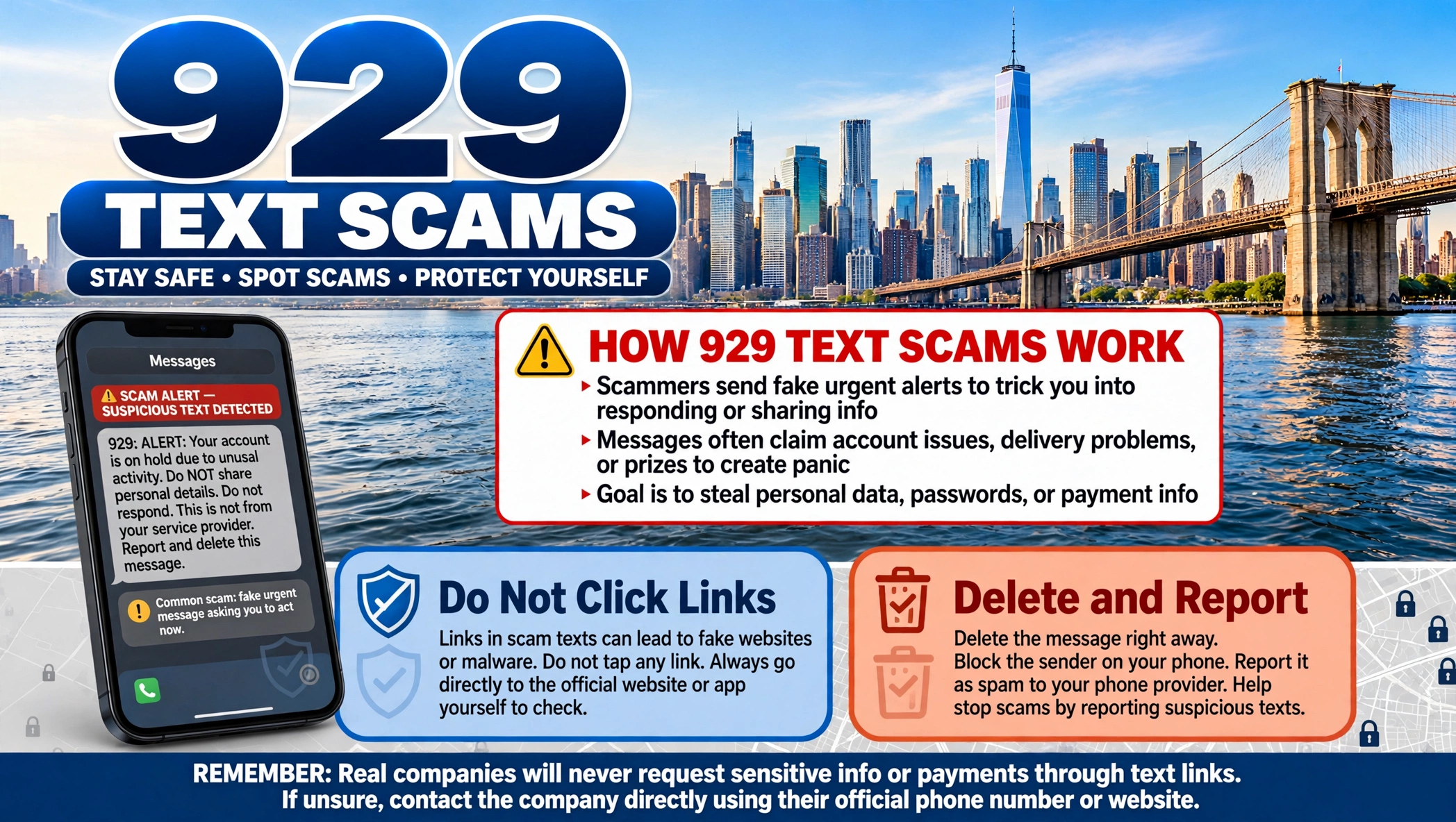
How 929 Text Scams Fit the Bigger Picture
Text scams are the messaging twin of scam calls, and the same defence works for both: the displayed number is not identity. Just as a 929 caller ID can be faked, a 929 sender can be faked, and a genuine 929 owner can also have nothing to do with the message you received. That is why this site links its text, WhatsApp, blocking and reporting guides together. The channel changes, the trick does not.
A final note on balance. Most 929 texts you receive from people and businesses you actually know are exactly what they seem. The code serves four boroughs and millions of residents, and daily life in Brooklyn, Queens, the Bronx and Staten Island runs on ordinary 929 calls and messages. The goal is not suspicion of every New York number. The goal is a simple habit: unexpected message, independent check. Follow that habit and a 929 text, real or fake, cannot rush you into a mistake.
Back to 929 Complete GuideFrequently Asked Questions
I got a text from a 929 number. Is it a scam?
Not automatically. 929 is a real New York City code, but scammers spoof it heavily. Judge the message by its content: unexpected links, urgent money or code requests and pressure to act fast are scam signs. Verify through official channels you look up yourself.
What is the package delivery text scam from 929 numbers?
It is a message claiming a parcel is held or needs a fee, with a link to a fake delivery site that steals payment or personal details. Check deliveries only in the official app or site you open yourself.
Should I reply to a wrong number text from 929?
No. Wrong number texts that turn into friendly ongoing chats are a documented scam pattern that can lead toward romance or investment fraud. Stop replying and block the number.
How do I report a 929 spam text?
Forward the spam text to 7726, block the number on your phone, and report fraud to the Federal Trade Commission and the Federal Communications Commission. State level complaints can go to the New York Attorney General.
Can a bank text from a 929 number be real?
Banks do send texts, but scammers copy the format. Never use the link or number in the message. Contact your bank through its official app or the number on your card instead.
Does a 929 number mean the sender is in New York?
No. Numbers can be spoofed and can be used from anywhere. A 929 code on a text does not prove the sender is in New York City.