Home > Safety > Is 929 a Scam?
Is 929 a Scam? Is a 929 Call Safe to Answer?
No, 929 is not a scam. It is a real New York City area code used by millions. But scammers spoof it heavily, so the smart question is not about the code, it is about the call. Here is how to judge any 929 call in seconds.
929 Area Code Guide | Eastern Time (ET)
The Direct Answer: 929 Is a Legitimate Area Code
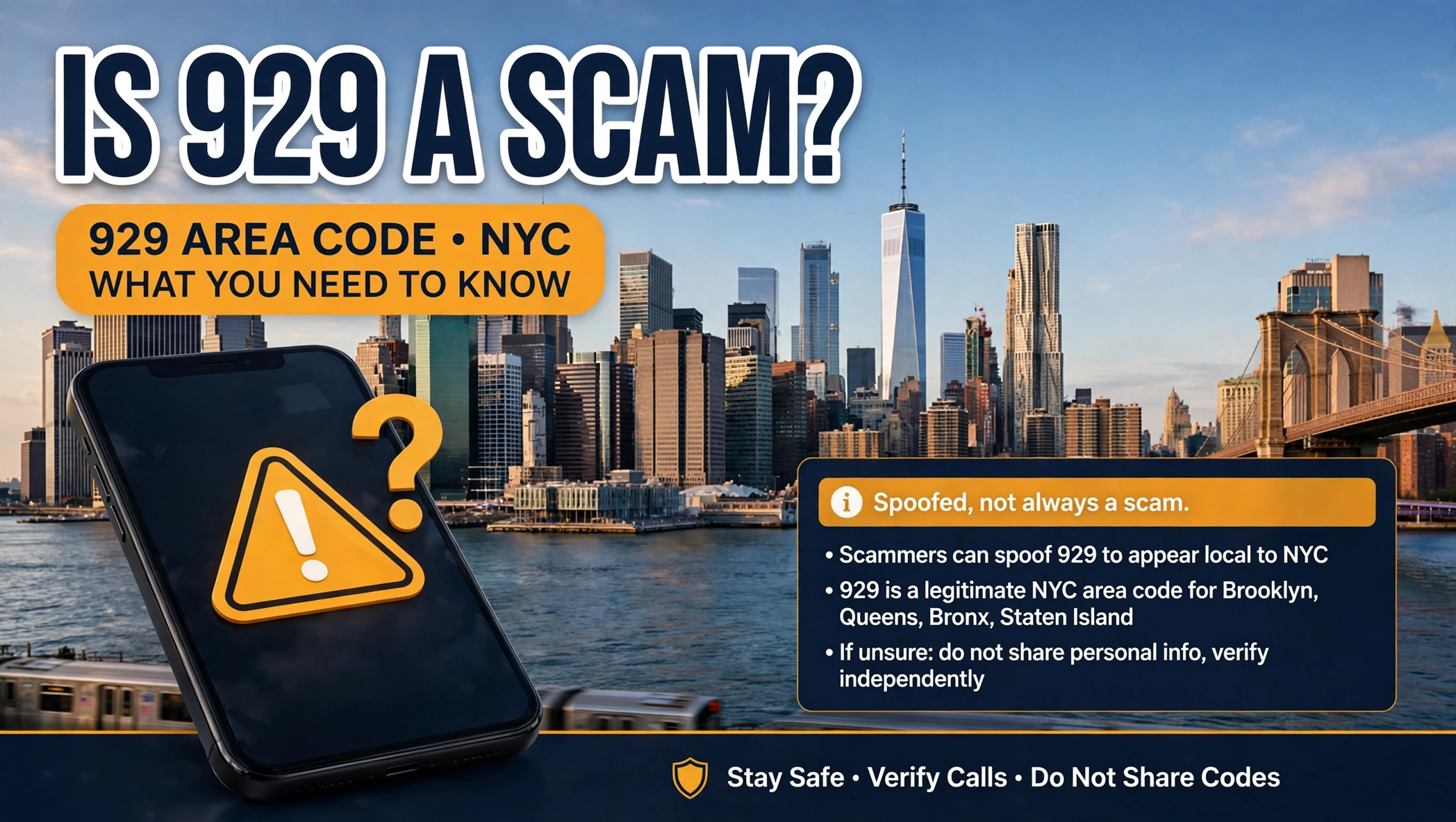
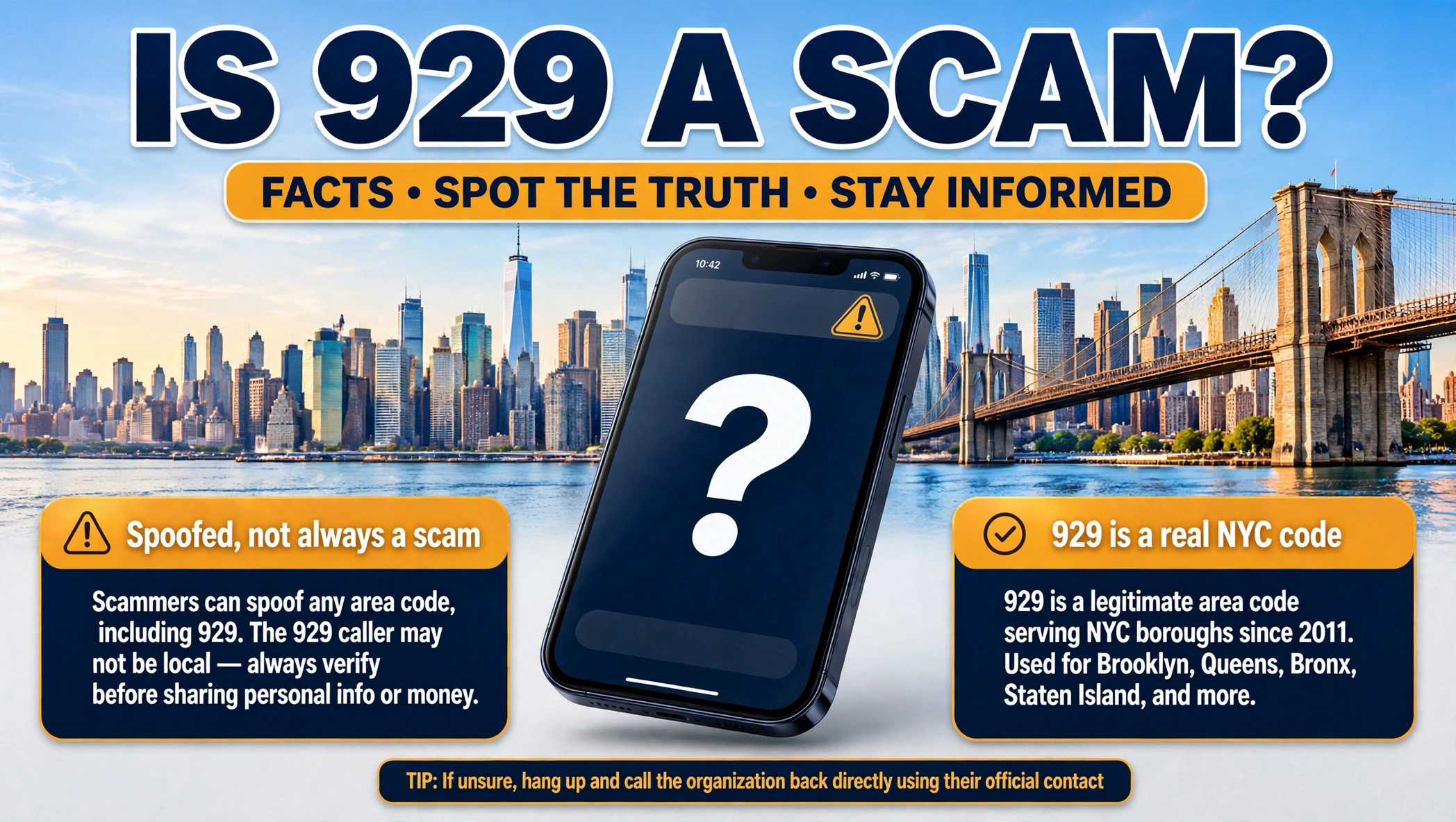
No, 929 is not a scam, a premium rate trick or a special kind of number. It is an ordinary geographic area code for New York City, serving Brooklyn, Queens, the Bronx, Staten Island and Marble Hill. It entered service in 2011 as an overlay of 718, the original outer borough code from 1984, and 347, the first overlay from 1999. The newest overlay, 465, joined the same territory on 18 June 2026. Calls to and from 929 numbers are standard domestic calls on Eastern Time, and the numbers are held by ordinary residents, businesses, schools, medical offices and public services across four boroughs.
So why does 929 have a suspicious reputation in search results? Because scammers heavily spoof it. Spoofing means displaying a number the caller does not own, and fraud operations choose believable local codes on purpose. A New Yorker is far more likely to answer a call that looks like it comes from Brooklyn than one from an unknown distant code. The scams are real. The conclusion that the area code itself is fake is not. Blaming 929 for spoofed calls is like blaming a street because a stranger wore its name on a badge.
When Is a 929 Call Safe to Answer?
A 929 call is low risk when the context already explains it. The number is in your contacts, you are expecting the call, perhaps a delivery, an appointment confirmation or a callback you requested, or the caller leaves a coherent voicemail that matches something real in your life and asks for nothing sensitive. Even then, the conversation should stay inside its purpose. A genuine caller confirming an appointment does not suddenly need your bank details, a one time code or a payment by gift card.
Treat a 929 call as high risk when it arrives cold and carries any of these features.
- Urgency: money, accounts, benefits or services will be lost unless you act during this call.
- Authority claims: the caller says they are from a bank, a government agency, a utility or tech support, uninvited.
- Sensitive requests: passwords, one time codes, full card numbers, remote access to your devices or personal documents.
- Unusual payment: gift cards, wire transfers, crypto or payment apps used to settle an official sounding debt.
- Secrecy: instructions not to hang up, not to call back on another number and not to tell anyone.
The safest default for any unknown number, 929 included, is simple: do not answer, and let voicemail do the screening. Scam calls need a live conversation. Legitimate callers leave messages. This one habit removes most of the risk without cutting you off from anyone who genuinely needs you.
Why the Number on Your Screen Cannot Settle the Question
Caller ID was built to display a number, not to prove identity, and modern calling technology lets fraudsters set the displayed number almost at will. That is why a 929 call can come from anywhere in the world, why a real subscriber in Queens can be completely innocent while their spoofed number annoys strangers, and why calling the number back can reach a confused bystander or nobody at all. Never call back an unknown 929 number, either to challenge it or to check it. Both impulses put you back inside the scammer chosen channel, confirm your number is live, and solve nothing.
Verification has to travel by a road the caller does not control. If a call claims your bank has frozen your account, open your bank app or ring the number printed on your card. If it claims a delivery failed, open the courier app yourself. If it claims to be an agency or utility, use the contact route from its official site, your bill or your paperwork. Two minutes of independent checking settles what an hour of arguing with a confident caller cannot, because you are no longer asking the suspect whether they are honest.
A lookup can add background, such as whether a number is widely reported, but it cannot certify a live call as safe. Use lookup results as one clue among several, with behaviour during the call as the deciding evidence.
A Calm Routine for Every 929 Call
Put the pieces together and the routine is short enough to use half asleep, which is when many scam calls are timed to land.
- Unknown number? Let it go to voicemail, whatever the area code.
- Message left? Listen, but do not use any callback number or link supplied inside it.
- Claim matters? Verify it through an official app, site, card, bill or office you find yourself.
- Pressure or requests for codes and payment? End contact at once. That combination is never legitimate.
- Scam confirmed? Block the number, forward scam texts to 7726, and report fraud to the Federal Trade Commission and the Federal Communications Commission, with state complaints handled by the New York Attorney General.
Follow that routine and the original question answers itself in practice. You never have to decide whether 929 is safe in the abstract, because you treat every unknown caller, on every code, with the same cool verification habit. The real New Yorkers behind real 929 numbers, in Brooklyn, Queens, the Bronx and Staten Island, will reach your voicemail and your callbacks just fine. The spoofed ones will reach a blocked number, a report file and nothing worth stealing.
Back to 929 Complete GuideFrequently Asked Questions
Is the 929 area code a scam?
No. 929 is a legitimate New York City area code serving Brooklyn, Queens, the Bronx, Staten Island and Marble Hill since 2011. The scam problem comes from fraudsters spoofing 929 numbers, not from the code itself.
Is it safe to answer a 929 call?
It is safe when you know the caller or are expecting the call. For unknown 929 numbers, the safest habit is to let the call go to voicemail and judge the message. Scam calls need a live answer, while genuine callers leave messages.
Why do I get so many scam calls from 929 numbers?
Scammers spoof local looking codes because people trust and answer them. If you live in or deal with New York, a 929 display looks familiar, which is exactly the effect the fraud operation is buying.
Can a 929 call come from outside New York?
Yes. Caller ID can be spoofed, so a displayed 929 number does not prove the caller is in New York or anywhere near it. Numbers can also be used remotely by their owners when travelling.
Should I call back a 929 number I missed?
No. Never call back an unknown 929 number. If the call was genuine and important, the caller will leave a voicemail or reach you another way. Verify any claim through official channels you look up yourself.
What do I do if a 929 call turns out to be a scam?
Hang up, block the number, forward any scam text to 7726, and report the fraud to the Federal Trade Commission and the Federal Communications Commission. If you shared money or information, contact your bank immediately.