
Home > Safety > Report a 929 Scam
How to Report a 929 Scam Call or Text
Reporting a 929 scam takes minutes, helps carriers block the next wave, and builds the record investigators use. Here is every route that matters: 7726, the FTC, the FCC, your carrier, and the New York Attorney General.
929 Area Code Guide | Eastern Time (ET)
Why Reporting a 929 Scam Is Worth Five Minutes
It is easy to feel that reporting changes nothing. The scammer used a spoofed 929 number, the call came from far outside New York, and deleting the message feels like the end of it. In practice, reports are the raw material of every defence that does work. Carriers use forwarded spam texts to train filters and cut off abusive senders. The Federal Trade Commission and the Federal Communications Commission use complaint patterns to spot campaigns, build cases and warn the public. The New York Attorney General tracks fraud aimed at New Yorkers at state level. A single report rarely triggers an individual investigation, but thousands of reports draw the map that enforcement follows.
Remember what you are reporting. 929 is a legitimate code for Brooklyn, Queens, the Bronx, Staten Island and Marble Hill, so you are not reporting the area code or its real owner. You are reporting a fraudulent call or message that displayed a 929 number, which the scammer may have spoofed without the real subscriber knowing anything about it. That distinction matters, and it is why reports ask what happened, what was claimed and what was requested, not just what number appeared.
Step One: Forward the Text to 7726 and Block
For a scam or spam text, the fastest and most useful report is built into the mobile network. Forward the message to 7726, a reporting number used by carriers for spam texts. On most phones you long press the message and choose forward, or copy the message exactly as received and send it to 7726. Your carrier may reply asking for the number that sent the text. Send that number exactly as shown, then delete the original message and block the sender in your phone settings.
- Do not tap any link in the message before, during or after forwarding it.
- Forward the text to 7726 exactly as received.
- Reply with the sending number if your carrier asks for it.
- Block the number in your phone, then delete the conversation.
Forwarding to 7726 works even when the displayed number was spoofed, because carriers also use the message content and sending patterns. Do the forwarding before blocking and deleting, while the evidence is still on your phone. If the message came through WhatsApp or another messaging app instead of SMS, use that app report and block tools as well, and treat the federal reports in the next section as your main formal record.
Step Two: Report to the FTC, the FCC and New York State
Three official routes cover a 929 scam properly. Each takes a few minutes and each feeds a different part of the response, so for a serious attempt, especially one involving money, personal information or threats, using more than one is worthwhile.
| Route | Best for | What to include |
|---|---|---|
| Federal Trade Commission | Fraud, impersonation and scam attempts of every kind | What was claimed, what was requested, the number shown, dates and any money or data lost |
| Federal Communications Commission | Unwanted and fraudulent calls and texts, robocalls and spoofing | The number shown, time of contact, and a description of the call or message |
| New York Attorney General | Fraud aimed at New York consumers at state level | The same core details, plus any loss or follow up contact |
File the reports through the official channels of each organisation, reached through sites or offices you look up yourself. Be careful here: scammers also create fake reporting pages and fake support lines. Never file a report through a link that arrived inside the suspicious message itself, and never pay anyone who offers to recover your money for a fee after a scam. Legitimate reporting is free.
If money left your account, add two urgent steps before or alongside reporting. Contact your bank or payment provider immediately through its official app or the number on your card, explain that the payment followed a scam, and ask what can be stopped or recovered. Then keep every record: screenshots, the number shown, times, receipts and report confirmations. Speed and documentation decide most recovery outcomes.
What to Save, What to Expect, and What Happens Next
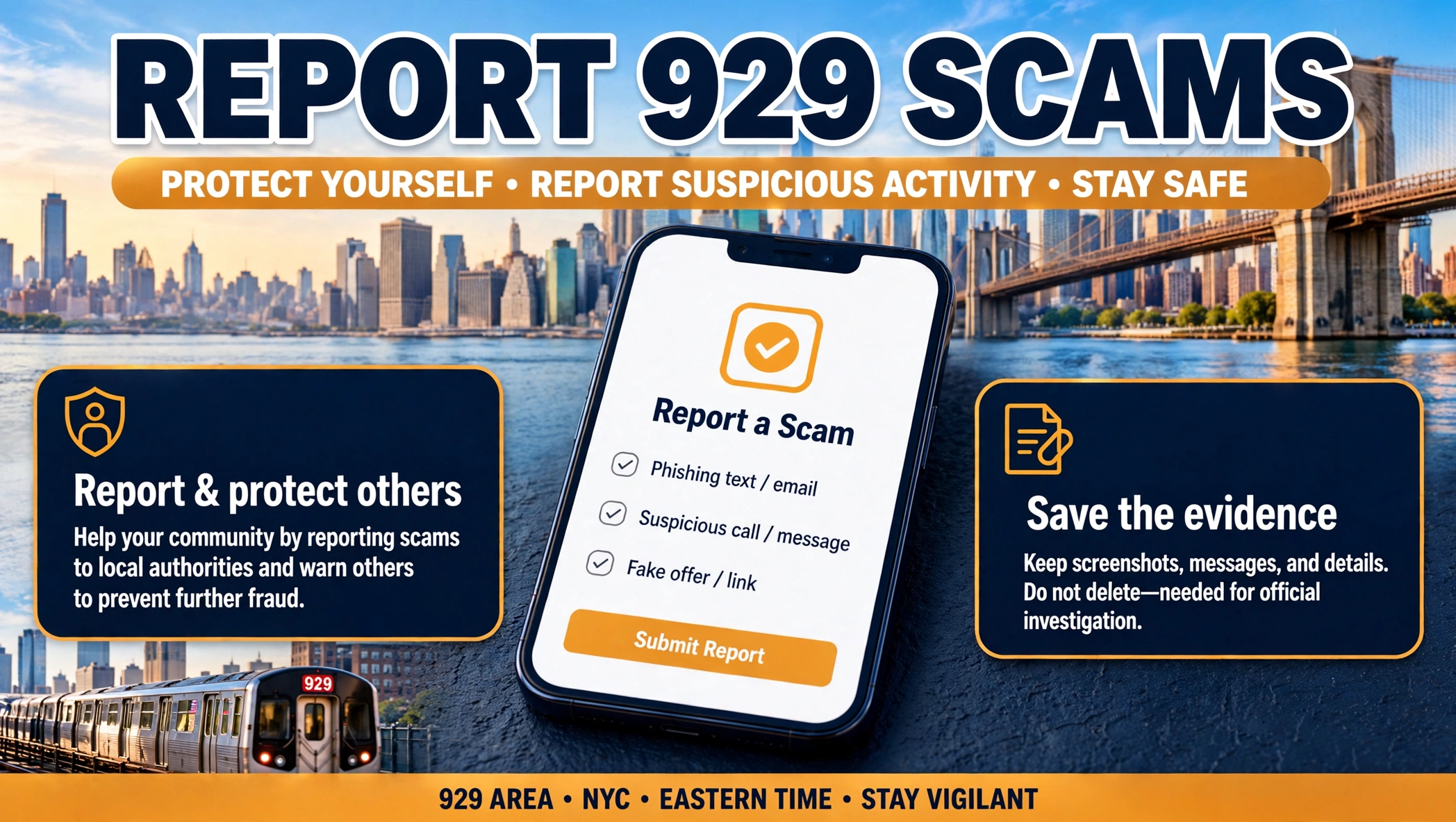
A good report is a clear one. Before you delete anything, save the essentials: the full number shown, including the 929 area code, the date and time in Eastern Time if you know it, the exact wording or a screenshot of the message, what the caller or sender claimed to be, what they asked for, and what you did, including any payment or information shared. If it was a call, write a short summary while it is fresh, including any names, organisations or callback numbers mentioned. Note that callback numbers in the message are evidence, not contact routes: never call back an unknown 929 number to investigate it yourself.
Set expectations honestly. Agencies generally do not reply with a personal case outcome, and a spoofed number means the trail rarely ends with one arrest. What reporting does is measurable at scale: spam sources get shut down faster, carrier filters get sharper, public warnings name active scripts sooner, and repeat campaigns become harder to run. Your report also protects you personally by creating a dated record if losses are later disputed with a bank.
Finish by tightening your own defences. Block the number, switch on the unknown caller and spam filters on your phone, and consider your carrier tool, Verizon Call Filter, AT&T ActiveArmor or T-Mobile Scam Shield. Then share the script, not just the scare, with family members who might be targeted next. A 929 scam reported, blocked and talked about is a scam that has lost most of its value.
Back to 929 Complete GuideFrequently Asked Questions
How do I report a 929 scam text?
Forward the text to 7726, reply with the sending number if your carrier asks, then block the sender. For a formal record, also report the fraud to the Federal Trade Commission and the Federal Communications Commission.
What is 7726 and is it safe to use?
7726 is the carrier reporting number for spam texts. Forwarding a suspicious text there is a standard, safe step. Do not tap links in the message itself, and never pay anything in connection with a report.
Should I report a 929 scam if I lost no money?
Yes. Reports of attempts still help carriers and agencies spot active campaigns and improve filters. A scam that failed on you may succeed on the next person, and your report is part of stopping it.
What details should my 929 scam report include?
Include the full number shown, the date and time, the message wording or a summary of the call, what the sender claimed and requested, and any money or information you shared. Save screenshots and confirmations.
Can I report a 929 scam at state level in New York?
Yes. The New York Attorney General handles state level consumer complaints about fraud aimed at New Yorkers, alongside the federal routes through the Federal Trade Commission and the Federal Communications Commission.
Will reporting get my money back?
Reporting alone does not guarantee recovery. If you paid, contact your bank or payment provider immediately through official channels, because speed matters most, and keep your report records to support any dispute.