Home / 929 Prefixes
929 Prefixes: How NPA-NXX Codes Work in the 929 Area
Every 929 number is built the same way: area code, prefix, line number. This guide explains what the three prefix digits mean, what they can and cannot tell you, and how to read a 929-XXX number with confidence.
Prefixes, carriers and rate centres explained
What Is a Prefix? The NXX in NPA-NXX
A full North American number has three parts. The first three digits are the area code, called the NPA. The next three digits are the prefix, also called the NXX or central office code. The final four digits are the line number for an individual subscriber. Written together, the pattern looks like 929-XXX-XXXX, where the XXX is the prefix.
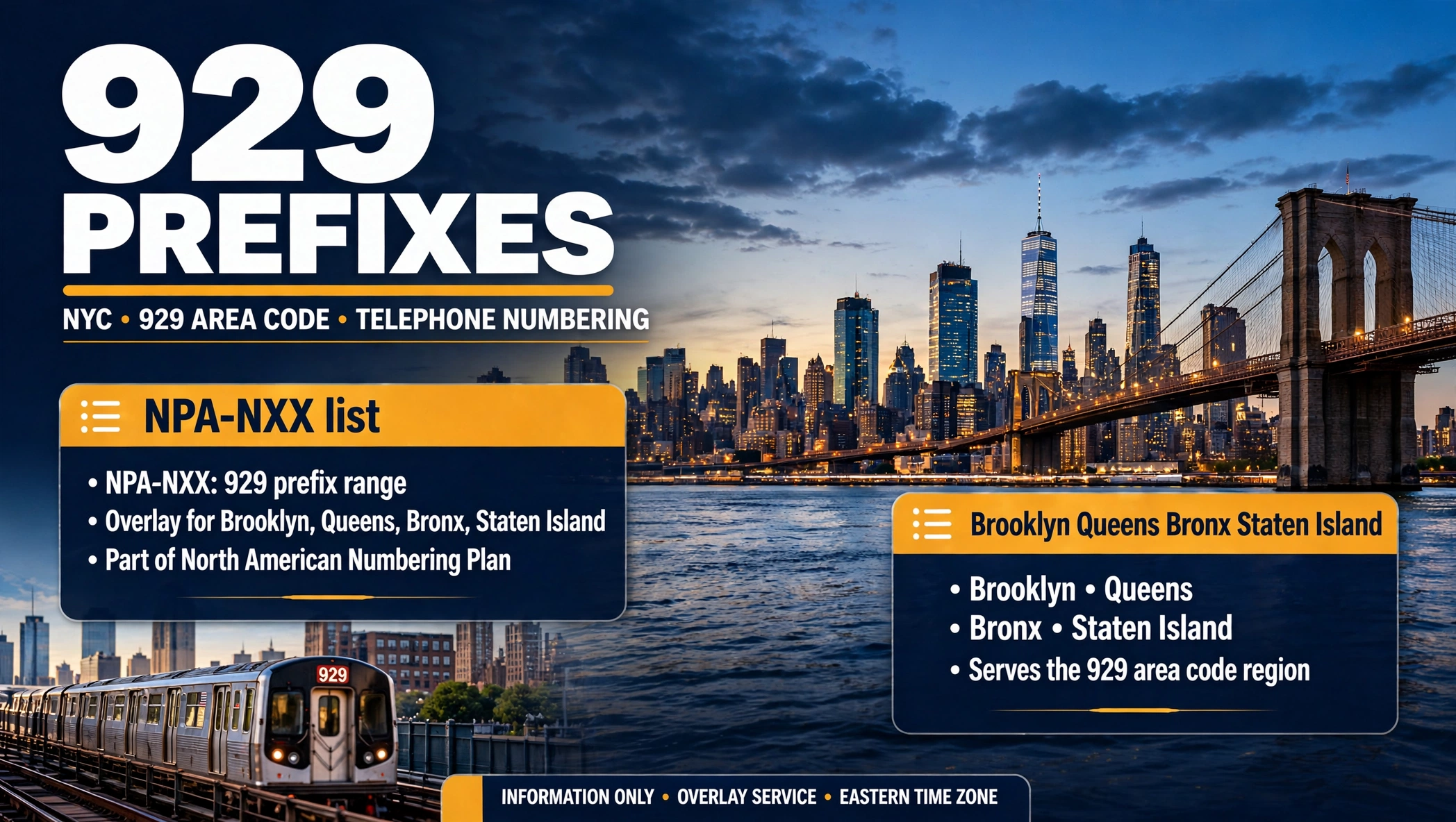
Think of it as an address in layers. The area code points to a region, in this case Brooklyn, Queens, the Bronx, Staten Island and Marble Hill. The prefix narrows that down to a carrier block and a rate centre. The last four digits then identify one specific line inside that block of up to 10,000 possible numbers.
What a Prefix Actually Identifies
When telephone numbering was planned, each prefix was assigned as a block. Two facts are attached to that block from the start:
- The carrier block assignee: the company the prefix block was originally assigned to. That may be a large mobile carrier, a landline provider, a cable voice provider or a VoIP company.
- The rate centre: the local exchange area used for rating calls. A prefix belongs to one rate centre, even though the subscriber can physically use the number anywhere.
Line type is a third useful signal. Across 929 prefixes, the split is about 62.4 percent wireless and 37.6 percent landline. That split describes prefixes, not individual people, and it helps explain why most new 929 numbers you meet belong to mobile phones.
How many 929 prefixes are there?
There is no single permanent total. Published counts of active 929 prefixes differ by source, ranging roughly from 590 to 700 in service, because assignments change over time and directories update on different schedules. Any page that prints one exact total without a date is likely out of date. On this site we describe the scale honestly: several hundred prefixes, growing as demand in the outer boroughs grows.
What a Prefix Cannot Tell You
Prefixes are helpful, but they have clear limits. The biggest limit is portability. Since number portability began, subscribers can keep a number when they change carriers. That means a prefix shows the original carrier, not necessarily the current one. A number that started on one network may now ring on a completely different network.
- A prefix does not prove who owns a number today.
- A prefix does not prove a caller is local, because numbers travel with their owners.
- A prefix does not prove a call is safe or a scam. Scammers can spoof any prefix, including ones that look familiar.
- A prefix does not give an exact address. At best it points to a rate centre area.
Used correctly, the prefix is a first check, not a final verdict. Combine it with a proper lookup and with common sense about the call itself.
How to Read a 929 Number Step by Step
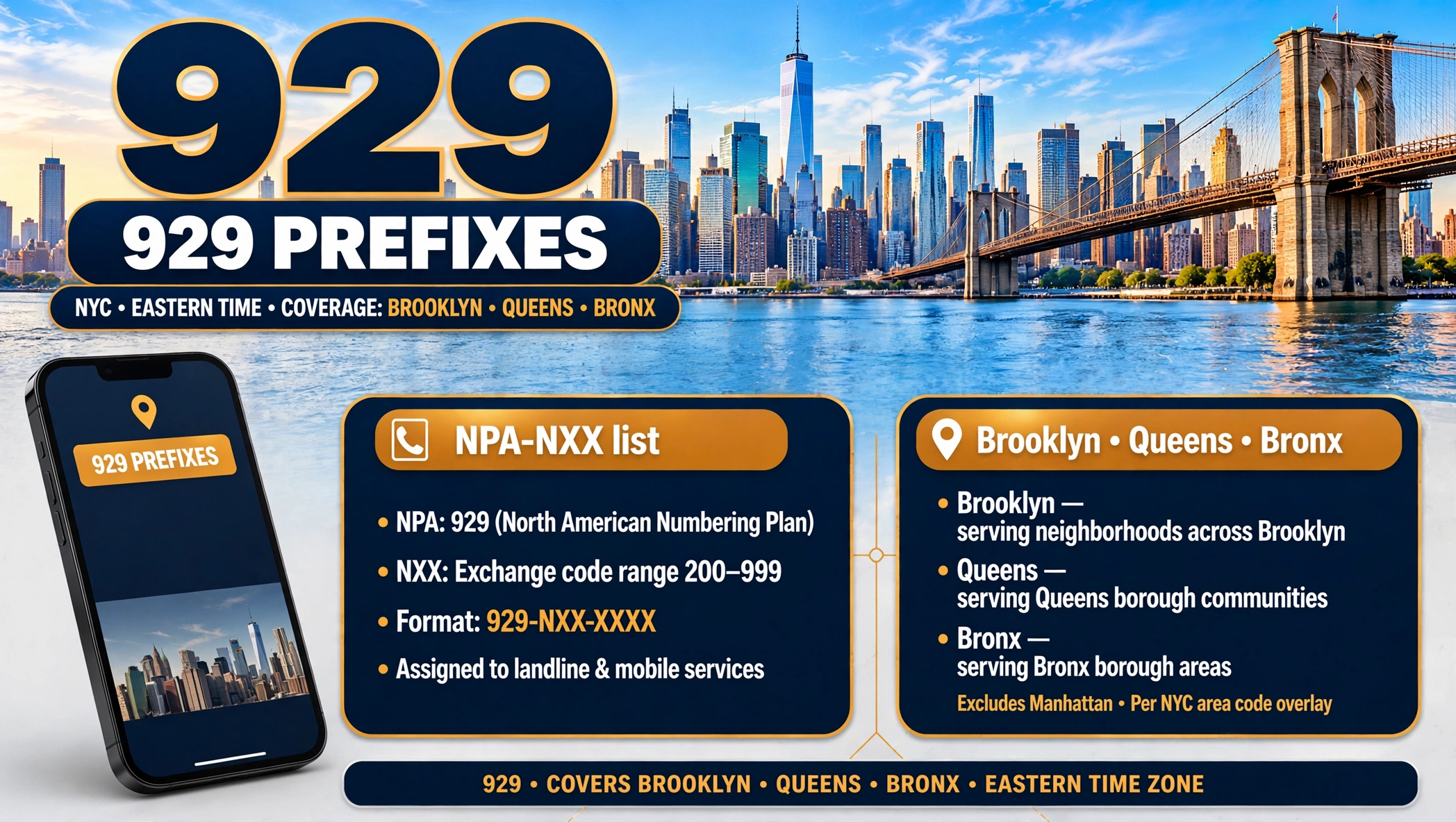
- Confirm the area code. 929 covers the four outer boroughs plus Marble Hill, as an overlay with 718, 347 and 465.
- Isolate the prefix. Read the three digits after 929. That is the NXX you need for a prefix check.
- Check the block. A prefix lookup shows the original carrier block assignee, the rate centre and the usual line type for that block.
- Allow for porting. If the current behaviour of the number does not match the block, portability is the most likely reason.
Frequently Asked Questions
What is a 929 prefix?
A prefix is the three digits that come right after the area code, in the format 929-XXX. It is also called the NXX or central office code. Together, the area code and the prefix form the NPA-NXX, which is how the phone network routes a call to the right exchange area.
How many 929 prefixes are in service?
Published counts differ by source and by date, ranging roughly from 590 to 700 prefixes in service. Counts change as new blocks are assigned and old ones are reclaimed, so treat any single total as a snapshot rather than a permanent number.
Does a prefix tell you the carrier?
A prefix shows the carrier the block was originally assigned to, called the block assignee. Because of number portability, the current carrier can be different if the subscriber has moved the number to another provider.
Does a prefix tell you if a number is a cell phone or a landline?
It gives a clue, not a guarantee. Across 929 prefixes, the split is about 62.4 percent wireless and 37.6 percent landline by prefix. An individual number can still have been ported from one line type to another.
What is a rate centre?
A rate centre is the local exchange area used for rating calls. In New York City, rate centres follow neighbourhood scale zones rather than city boundaries, which is why one city can have many rate centres listed for the same area code.
Can I look up a specific 929 prefix?
Yes. Note the three digits after 929 and use the number lookup guidance on this site to check the prefix, the original carrier block and the rate centre. Remember that portability can change the current carrier.